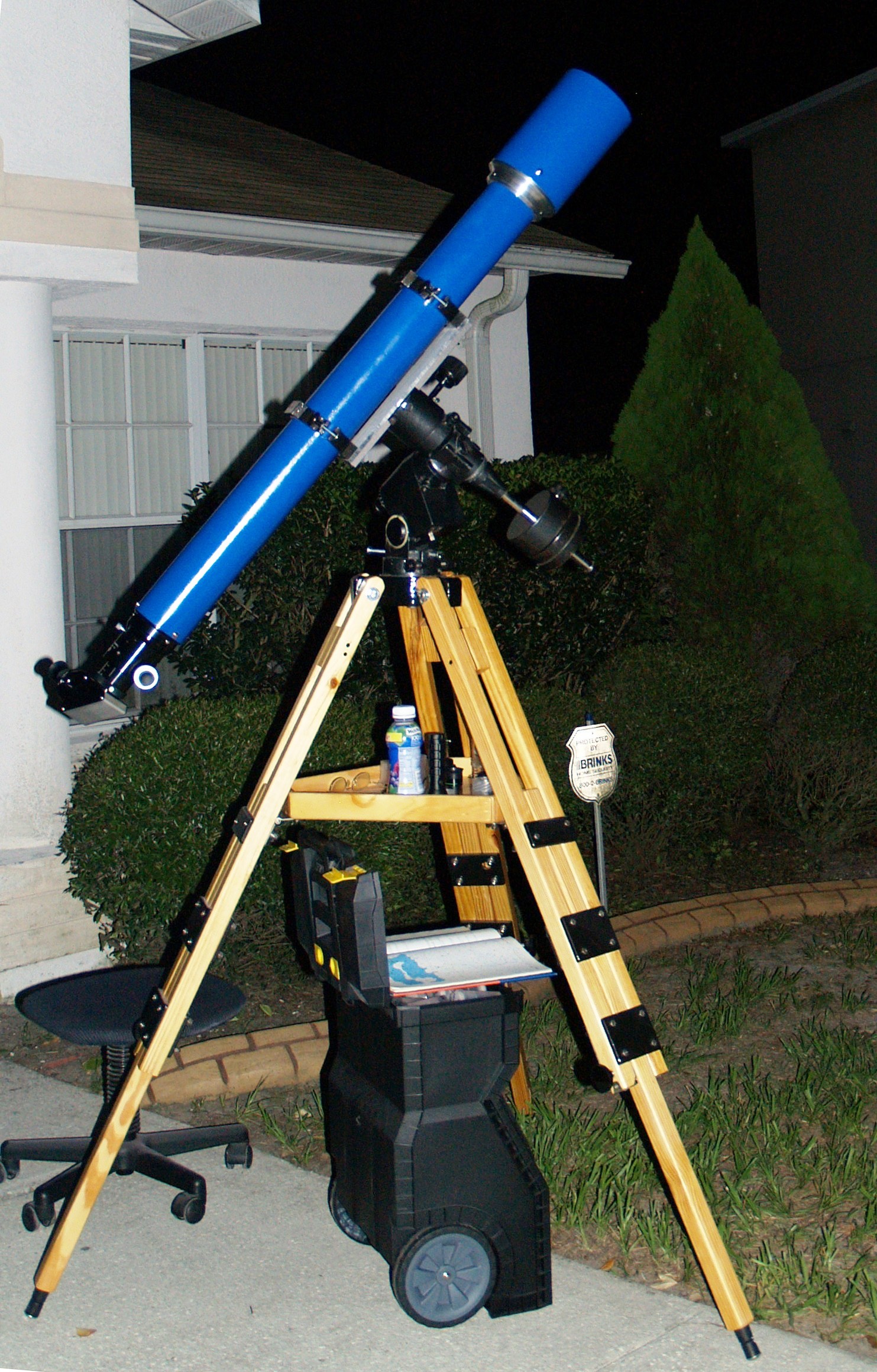
Thanks for checking out
the construction overview of the VSC/ SAO Carton 100mm f/13 "Mary
Dawson" refractor telescope. Below I have put a copy of my First
Light report, which I also posted under Vega News! webpage, as well
as on the Cloudy Nights. The photo above was taken on the night of
First Light,
July 10, 2010.
Thanks to everyone who supported this build.
Hello
Good Friends,
As some of you may already know, I am recovering from a stroke that
took place on the morning of June 20, 2010, which was Father's Day.
Thanks to God and the prayers, strength, and support of so many of
you, I am happy to announce that I received the best gift any one
could receive - LIFE! Because of this blessing, I also was able to
perform First Light with my Carton 100mm f/13 "Mary Dawson"
refractor on July 10, 2010! Less
than a month after my sudden demise. Here is my report...
First Light
with the VSC/ SAO Carton 100mm f/13
"Mary Dawson"
Refractor on July 10, 2012
As dusk
came and the skies turned a deep teal blue at around 9:00pm EDT, my
first target with the “Mary Dawson” refractor was Venus. Using a
TeleVue 15mm Plossl, which yield a magnification of 87x, I slowly
focused Venus in the field of view and was very pleased at the image
I was seeing. Despite some purple fringing, Venus was very sharp and
CA was held very, very low even though Venus was low in the sky.
Typically, viewing objects that low in the sky would general tease
out the CA of many a celestial object. But, the instrument held this
aberration to an extreme minimum; impressive indeed! Enjoying the
view, I moved up to a TeleVue 11mm Plossl. This gave me a power of
118x. At this magnification I could easily make out slight
irregularities in the Venusian terminator of its gibbous phase. That
was quite a sight! It was the best view I have ever seen through any
refractor I have owned. Again, purple fringing was present, but in
no way was it an issue. CA was practically nonexistent. Contrast was
outstanding throughout the test.
Darkness settled in good at about 10:00pm EDT, and it was time to
check out some of those DSO’s and Double Stars! With my good friend
Gary Barabino on the other end of the phone, he suggested that I
check out M13, the Hercules Cluster. The globular cluster was
approaching the meridian from my vantage point and prime for
viewing. I realize that the 100mm is not a light bucket; however I
wanted to see what it could do on DSO’s. Bright globular clusters
can produce surprisingly beautiful images when put under moderate
magnification. It was no surprise in the Carton. M13 was resolved to
the core with ease at 87x with a TeleVue 15mm Plossl. At 118x
with the TeleVue 11mm, the core sparkled like diamonds. I only wish
I was out at a dark remote site to take it all in. The next DSO I
chose to check out was M57, the Ring Nebular. Why the Ring Nebula?
Well, I wanted to see how well the optics of this “four incher”
would fair on an object that is generally viewed with large aperture
telescopes. Once again, I was quite impressed with the image. The
ghostly ring stood out even at 118x! Of course, seeing the central
star was impossible. Nevertheless, you could make out the shape and
some faint structure in the ring’s nebulosity. I am really digging
this scope, man!
Around 10:45pm EDT, I decided to check out a couple of brightest
stars. First up was Arcturus. This star produced a very tight disk
with minimal flaring. Diffraction rings (two) were close to the
star’s disk and the color was a pale orange. Only a little purple
fringing was discerned. Very nice image! Next up was Vega. Again
tight diffraction rings (two) and the color appeared a brilliant
blue-white. Purple fringing was a bit more prominent on Vega as
compared to Arcturus, but nothing to be upset over at all.
Moving on, it was time to check out a double star, and the one of
choice was Epsilon Lyrae, the Double-Double. What really struck me
was how tiny the disks of the stars were. Also how tight the
diffraction rings were in relation to the stars. Simply amazing how
small the airy disks were.
I wanted to check out a few more objects, but I started to get a bit
tired. So at around 11:30pm EDT, I called it a night. In conclusion,
I could not have asked for a better result after tonight’s First
Light session with my Carton 100mm f/13 “Mary Dawson” refractor.
Total success was achieved! Doug is so right to exonerate the
attributes of this fine instrument the way he does. It literally
produces APO like image quality, but in a larger package. However,
an APO would never touch the magnification this lady could produce.
I am very pleased with this instrument and will be reporting back
with more observing session details in short order! If you want a
telescope in the 4” range, get yourself one of these objectives. I
saved plenty cash in building my own like many others here on this
thread. But, the optical results of this refractor are worthy of
telescopes costing far more.
If you
have any questions, or concerns or would like to know more about
this fine instrument, please forward you inquiries to the email
address listed below.
Thanks,
God Bless and Clear Skies, Forever!!!
vsc-astronomers@vega-sky-center.com
|
|